
Natural resource
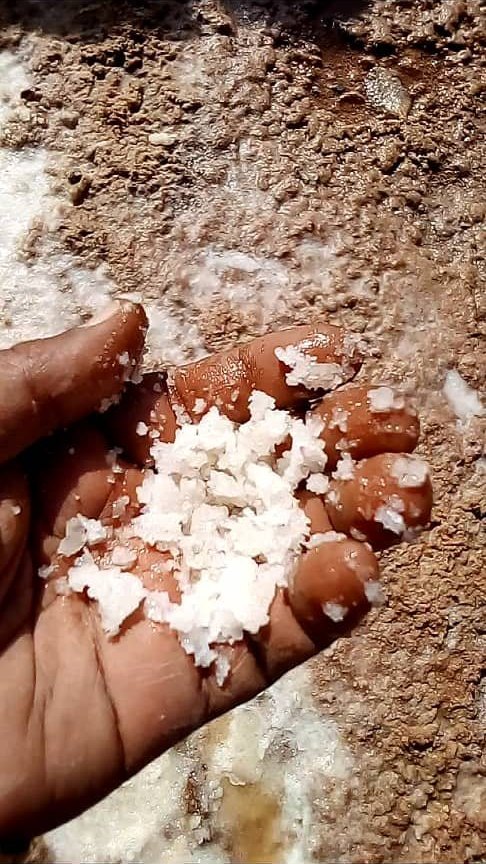
Surface salt crusts and saline groundwater are documented in the Habulay basin.
Noolays is developing a salt production and processing business in eastern Ethiopia. The resource is documented and the survey work is complete; the next stage is a pilot plant that confirms the operating and cost figures. The cooperative is seeking partners who can contribute capital, equipment, technical know-how or market access. This page sets out what is on offer, what is already in place, and the questions we expect to be asked.
Most salt in the region is still produced by traditional methods. The resource, the market and the local institutions are in place; the missing element is industrial capability — equipment, capital and market access. That is the partnership we are seeking, and this page states clearly how far the project has reached.
Surface salt crusts and saline groundwater are documented in the Habulay basin.
The cooperative is member-owned; its committee lives and works in the project area.
Solar evaporation, washing, refining, iodization and packing are proven, widely used processes.
Capital is released against verified milestones rather than all at once.
Salt is an everyday commodity in Ethiopia; product quality, price and transport are the commercial variables tested first.
Washing, refining and packing raise the value of every tonne above raw salt.
Build a small working plant first. It gives us real numbers on cost, output and quality — the basis for every later decision.
This stage replaces assumptions with measured results, documented so that a partner can review the same figures we use.
With proof in hand, we build a larger operation. The size is set by the pilot results, the market and the money available.
The end goal is one integrated business: salt production, refining, edible and industrial products, livestock salt and delivery.
You do not have to bring money to be useful. A supplier might install equipment and train our team; a distributor might commit to buying. Terms are agreed case by case, depending on the stage of the project and the law.
Different partners want different things, so none of these is fixed. Whatever we choose is written down only after legal, technical and financial checks, and after both sides have agreed it.
You put in money and hold an agreed share of the project.
We set up a company together with agreed money, roles and ownership, and both sides sit on its board.
You supply machines, technology or technical services on agreed commercial terms.
Machines are supplied now and paid for over an agreed period, subject to due diligence and applicable law.
A buyer agrees to take agreed volumes at agreed quality and terms once the pilot has proved output.
Money, equipment, management and market access together — what most serious partners choose when they want a say in how the project is run.
Capital follows evidence: test, measure, then scale. That is why the first requirement is a pilot programme rather than a full plant, and why investment is released against verified milestones.
Noolays is not presenting a completed facility. It offers a structured route to build one: resource, capital, technology, management and markets developed step by step, supported by verifiable results.
The budget is split by stage, so you can see what each step costs. The exact figures come from engineering design, supplier quotations, pilot results and a financial model, and are given to qualified partners on request.
Pilot budget figures go to qualified partners on request — we do not publish them here.
No resource project is risk-free. The principal risks and the way each is managed are set out below.
| What can go wrong | What we do about it |
|---|---|
| The method does not work | We prove it in a pilot first — and pay an independent engineer to check the result. |
| Less salt than expected | More sampling and testing before any large spending. |
| Machines do not suit our salt | We test equipment on site before buying at scale. |
| Buyers reject the product | Real samples go in front of real buyers from the pilot stage. |
| Costs run away | Money is released stage by stage, against agreed milestones. |
| Damage to land or water | Environmental study, monitoring and clear operating rules. |
| Day-to-day running fails | Training, maintenance, quality control and professional management. |
Tell us who you are and what you are interested in.
We send the introductory project information and answer your first questions.
If you want more, we sign a confidentiality agreement and you start your own legal, technical and financial checks.
Qualified partners can visit the site and see the resource and the plans for themselves.
Together we look at the pilot plan, the equipment, the costs and the market.
We agree how we work together — share, company, equipment supply, credit or an advance purchase.
The pilot goes ahead, with clear results expected at each step.
With the pilot results verified, we decide together whether to scale up.
If the checks, the money and the results line up, the project moves to larger production and processing.
A checkpoint on the way to production.
A checkpoint on the way to production.
A checkpoint on the way to production.
A checkpoint on the way to production.
A checkpoint on the way to production.
A checkpoint on the way to production.
A checkpoint on the way to production.
A checkpoint on the way to production.
A checkpoint on the way to production.
Building a plant here should give work and business to the people around it, not just take a resource out and sell it.
The Somali Regional State's own investment platform lists salt among the region's mineral resources and invites investment in mining and manufacturing. Invest in Somali (investinsomali.gov.et).
The Ethiopian Investment Commission also treats mining as a priority sector and points to opportunities in developing and processing minerals. Ethiopian Investment Commission.
Between survey and pilot. The survey report for the Habulay basin is complete and the pilot programme is being prepared. Commercial production has not yet started.
No, and we are careful with the wording. The figures on this site are our own preliminary estimates from field work and satellite analysis — not a certified resource statement. The next steps are ground surveys, three to five shallow test holes and a pilot. You are welcome to bring your own independent expert at any stage.
It is split by stage: first the pilot (preparing the site, ponds, pumps, test holes, pipes, harvesting equipment, laboratory tests, basic facilities, vehicles and running money), then processing equipment, then expansion. The exact figures come from engineering design, supplier quotations, pilot results and a financial model. Pilot budget figures are provided to qualified partners on request.
Yes. Qualified partners can visit, inspect the resource and meet the committee. Contact us in advance so we can arrange access, transport and a guide.
It is open to discussion and depends on you and the stage: a share of the business, a company together, technology or equipment supply, equipment on credit, an advance purchase agreement, or a mix. Whichever we choose, Ethiopian cooperative law and our members decide how the resource itself is held.
In Ethiopia land is public and administered by the state; use rights are granted to users and investors under federal and regional law. Land documents, site handover records and permits form part of the information provided to qualified partners.
Company documents, land and legal papers, survey and water studies, laboratory results, environmental information, market assessments, cost estimates and the development plan. The full list is in section 9 of the Project overview & information page. Sensitive papers are released after a confidentiality and due-diligence arrangement.
Every request is handled by a named person. If you need more than the public summary, we sign a confidentiality agreement before anything is released, and technical or financial data goes only to your organisation under that agreement.
Tell us what you would need to see before committing — data, engineering, legal structure or a site visit. We will set out clearly what is available and what is not.